Disarming a Critic
Making visible and dismantling our self-limiting beliefs
How visual tools can help us recognize and work with the mental structures that shape our experience.

Self-limiting belief
“It feels like a blade swinging back and forth across the top of an imaginary box. If I start to move or grow outside the box, I get cut off.”
“It feels like a blade swinging back and forth across the top of an imaginary box. If I start to move or grow outside the box, I get cut off.”
This was the image that came to me during a peer session of Compassionate Inquiry (CI) when I was asked how I experienced my inner critic.
“It’s sharp,” I explained. “It cuts me off when something I’m about to say feels incorrect, off, or somehow not enough.”
What interested me was the image itself. Where had this imaginary box come from? Who had determined its boundaries? And what standard was the blade enforcing?
The critic was familiar, but seeing it this way created an opportunity for inquiry. Rather than simply noticing that a critical voice was present, I could begin to perceive something about how it operated.
Compassionate Inquiry, a psychotherapeutic approach developed by Gabor Maté and Sat Dharam Kaur, offers a process for exploring some of the beliefs, assumptions, and stories that operate beneath our conscious awareness. During the session, we explored a recent experience in which this critical response had surfaced, the beliefs associated with it, and some of the experiences that may have contributed to its formation.
Afterward, I sketched what I had perceived.
The drawing was simple, but externalizing the experience visually changed my relationship to it.
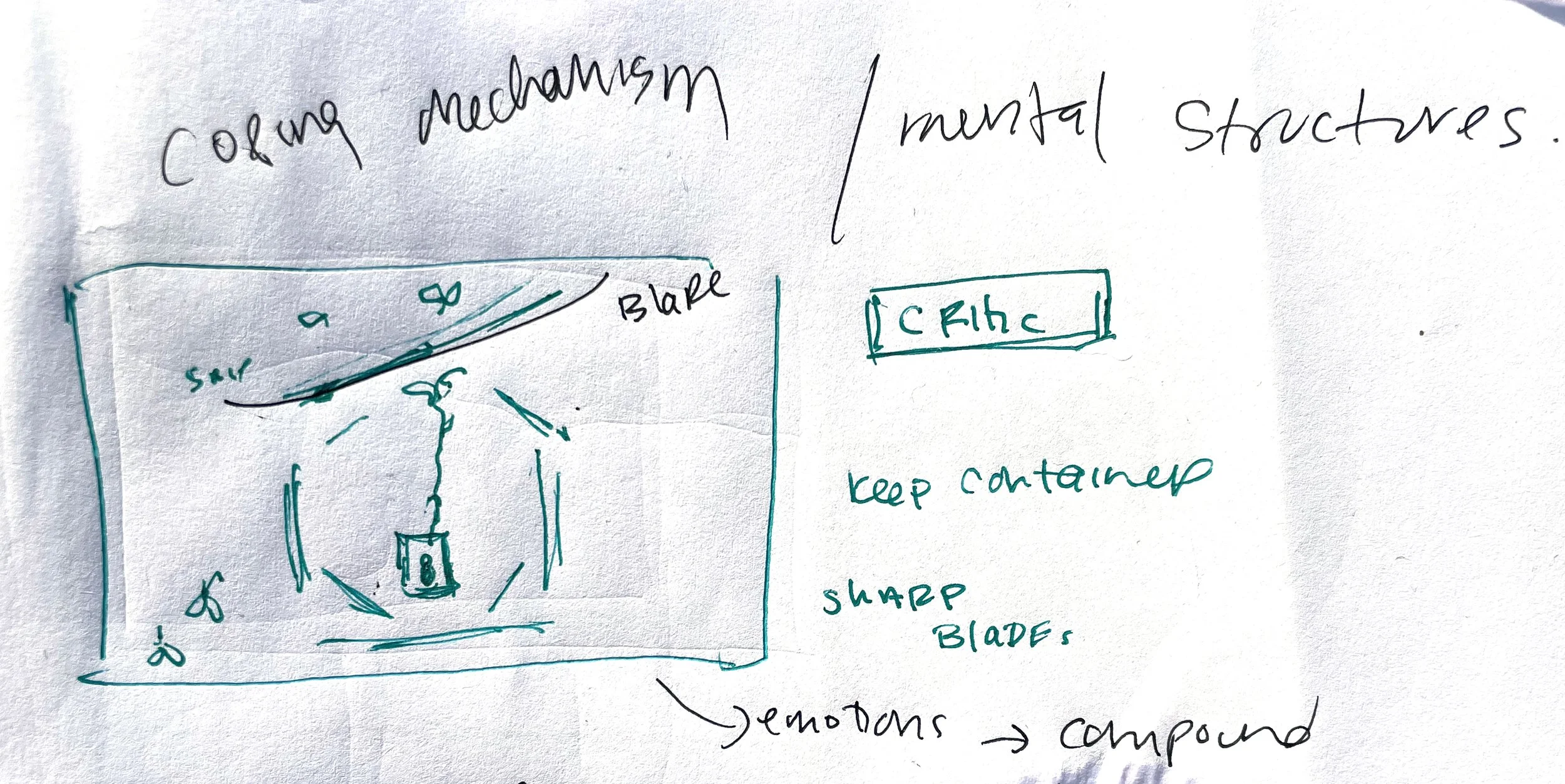
Self-study: Intuitive sketch after a peer practice CI session
It became a mirror.
Because the sketch emerged intuitively, I could look back at it almost as an artifact. What did the blade represent? What was inside the box? What happened at its edges? The image gave me something concrete to investigate.
It created distance.
Instead of experiencing the critic simply as part of “me,” I could see it as a process or pattern occurring within me. That distinction created more room for curiosity.
It invited compassion.
Once I could see the pattern more clearly, I could become curious about its function rather than simply wanting it to disappear. What was it trying to protect? Why might this response have once been useful?
It gave me something I could work with.
The image became a metaphor I could return to through journaling, reflection, and other inquiry practices. An elusive internal experience had become something more tangible.
This experience made me curious about the broader potential of visual tools for working with limiting beliefs and mental structures.
Many of us carry beliefs about what is safe, possible, acceptable, or expected of us. Yet these beliefs can be difficult to recognize precisely because they operate largely in the background. When we give them a shape, character, relationship, or spatial arrangement, we create an opportunity to see them differently.
The drawing does not need to be “accurate.” Its value may lie in what it allows us to notice.
I began experimenting with this idea in my work with others as well.

Client study: A critic’s attempt to prioritize safety over failure
One client, for example, described wanting to move forward in her career and more fully express her gifts, while simultaneously experiencing a persistent sense of constraint. She described the experience through the metaphor of a newly repotted plant:
“There is a pull outwards and an urge to grow toward my potential. On the inside, I’m bursting forth and wanting to share my gifts with the world, yet I am constrained.”
Over two sessions, there were several mentions of moving forward and then hitting brick walls, followed by grief. Loss of life force and trust in herself were also themes. I jotted down all the associated beliefs during the sessions and later mapped them to the metaphor provided of the plant.
Drawing these out helped me see a possible pattern and several interacting dynamics at once.
I have come to think of these drawings as a kind of experiential mapping.
They are not diagnoses or representations of objective reality. They are provisional maps of an experience: a way of giving form to something that can otherwise remain difficult to perceive.
And perhaps that is where their usefulness lies.
When an internal structure becomes visible, we can become curious about it. We can examine its relationships, question its assumptions, understand what function it may have served—and begin experimenting with what might become possible beyond it.